Anterior Cervical Discectomy & Fusion (ACDF)
Anterior cervical discectomy and fusion (ACDF) is an operation to relieve pressure on the spinal nerves or spinal cord in the neck. It involves removing a damaged disc and stabilising the affected vertebrae while they fuse together.
Understanding the Procedure
What is an ACDF?
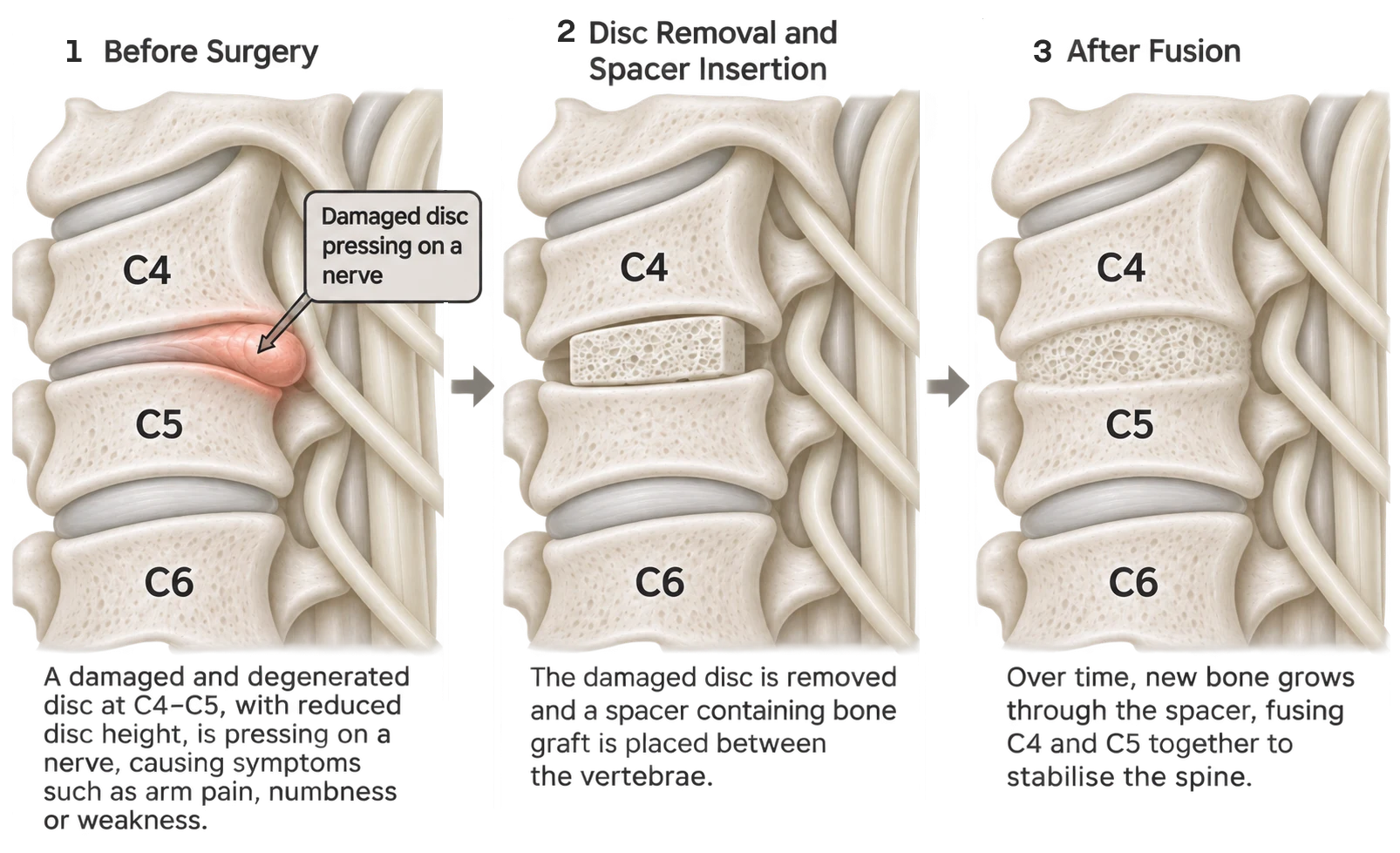
ACDF is a procedure performed through an incision at the front of the neck.
The surgeon removes the damaged disc pressing on the spinal nerves or spinal cord. A spacer containing bone graft is then inserted between the vertebrae to restore disc height and support fusion.
Over time, new bone grows between the vertebrae, joining them together. This stabilises the treated level but reduces movement at that level.
Indications
When is this Procedure Recommended?
ACDF may be recommended when nerve or spinal cord compression is causing significant symptoms.
Common reasons include:
- Persistent arm pain, numbness or weakness caused by a compressed nerve
- Progressive weakness related to nerve compression
- Cervical myelopathy (spinal cord compression affecting nerve function), causing problems with walking, balance or hand coordination
For nerve-related arm pain, surgery is usually considered when appropriate non-surgical treatment has not helped.
When spinal cord function is deteriorating, surgery may be recommended sooner to prevent further damage.
An abnormal MRI alone does not mean surgery is necessary. The decision depends on your symptoms, neurological examination and scan findings.
The Procedure
What Happens During Surgery?
The operation is performed under general anaesthesia.
- A small incision is made at the front of the neck.
- The affected disc is identified.
- Using an operating microscope and microsurgical techniques, the surgeon removes any disc material pressing on the spinal nerves or spinal cord.
- A spacer containing bone graft is placed between the vertebrae to restore disc height and support fusion.
- The wound is closed and covered with a dressing.
The vertebrae gradually fuse together over the following 6–12 months, although bone remodelling continues afterwards.
Related Conditions
Benefits
Potential Benefits
The aim of ACDF is to relieve pressure on the spinal nerves or spinal cord by removing the injured disc, and stabilise the affected spinal level with a spacer.
Potential benefits include:
- Relief of radiating arm pain
- Improvement in numbness and tingling
- Recovery of muscle strength
- Improved hand function, walking or balance in patients with myelopathy
- Prevention of further spinal cord deterioration
When can I expect improvement?
- Arm pain: Often improves within days to weeks.
- Numbness and tingling: May improve over weeks to months.
- Muscle weakness: Recovery may continue for 6–12 months.
- Walking, balance and hand coordination: Improvement after spinal cord decompression may occur gradually and over several months.
Recovery depends partly on how severely and for how long the nerve or spinal cord was compressed. Longstanding symptoms may not recover or only partially recover.
After the procedure
Recovery After Surgery
Most patients spend around two nights in hospital and return home once they are walking safely, swallowing adequately and their pain is controlled.
Some neck discomfort, soreness around the incision and difficulty swallowing are common during early recovery.
Swallowing discomfort and temporary voice changes usually improve over days to weeks. Arm pain may improve sooner, while recovery of numbness or weakness can take several months.
Walking is encouraged from the first day after surgery.
Avoid heavy lifting, strenuous activity and excessive neck strain during early recovery. Activity is increased gradually according to your surgeon's advice.
Although you may feel better within weeks, the bone fusion takes several months to develop.
A consultation with a spine physiotherapist before surgery can help provide advice about early recovery and exercise restrictions.
A structured Physio program may begin around 6–8 weeks after surgery, depending on your progress and the surgeon's advice. Rehabilitation focuses on restoring movement, strength and confidence with everyday activities.
You can return to driving when you can turn your neck comfortably, control the vehicle safely and are no longer affected by pain or medication. Follow your surgeon's advice before resuming driving.
Many patients return to office-based work within 4–6 weeks.
Physically demanding work may require a longer recovery period or a gradual return with modified duties.
Follow-up appointments are usually arranged at 2 and 6 weeks, with further reviews as required.
Potential Complications
Risks and Complications
Most patients don’t have complications but recognised surgical risks include:
- Infection or bleeding
- Blood clots
- Anaesthetic complications
- Temporary swallowing difficulties or hoarseness
- Failure of the vertebrae to fuse (non-union)
- Nerve injury
- Implant problems needing further surgery
- Degeneration of adjacent levels over time
Your surgeon will discuss the risks relevant to your condition and the procedure planned.
Considering ACDF Surgery?
Our team can help determine whether surgery is appropriate and discuss all available treatment options.