Anterior Lumbar Interbody Fusion (ALIF)
An ALIF is an operation to replace a damaged disc in the lower back with an implant that allows two vertebrae to fuse together. It is considered for selected patients with spinal instability, spondylolisthesis or recurring disc herniation.
Understanding the Procedure
What is an ALIF?
Anterior lumbar interbody fusion (ALIF) is performed through an incision in the lower abdomen to reach the spine from the front.
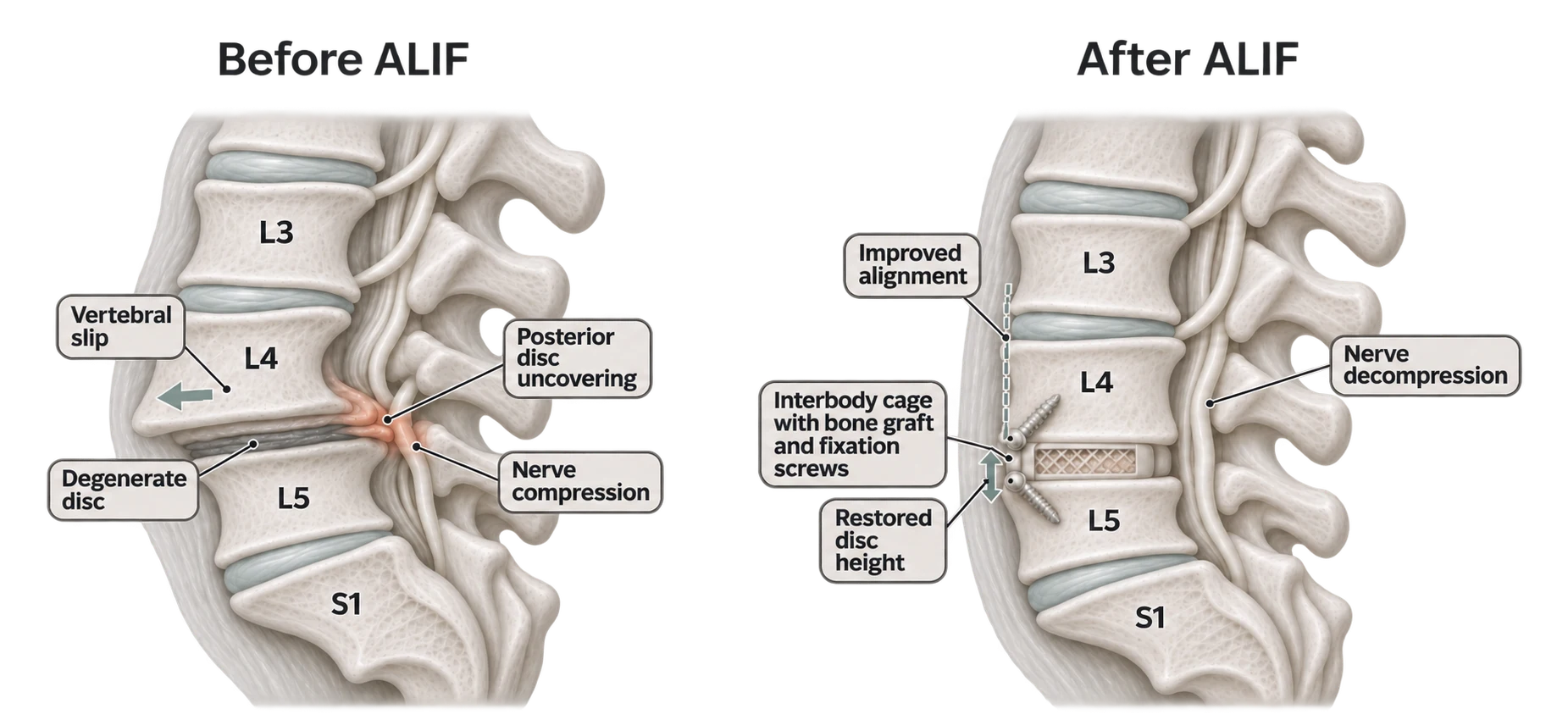
The damaged disc is removed and replaced with an interbody cage (spacer) containing bone graft. This can restore disc height and alignment and provide stability while new bone grows between the vertebrae. The cage stays in place permanently, while the bones gradually fuse together.
Approaching the spine from the front allows the surgeon to use a larger implant without cutting through the muscles in the back. Restoring disc height can also create more room for nearby nerves, although some patients need a separate operation to directly relieve nerve compression from behind.
Our Collaborative Surgical Approach
At Sydney Spine Institute, Associate Professor James van Gelder performs ALIF in collaboration with an experienced vascular surgeon.
The vascular surgeon provides the abdominal approach, carefully moving the major blood vessels and surrounding structures aside to access the spine. Professor van Gelder then performs the disc removal, reconstruction and fusion.
Working together brings specialist expertise to both the abdominal access and the spinal procedure.
Indications
When is this Procedure Recommended?
An ALIF may be recommended when instability or severe disc degeneration in the lumbar spine is causing ongoing nerve compression and pain symptoms that have not improved with non-surgical treatment.
Reasons may include:
- Painful spinal instability associated with spondylolisthesis in selected patients.
- Severe disc collapse or degeneration causing nerve compression.
- Recurring disc herniation causing sciatica
- Selected cases of spinal deformity or instability following previous surgery.
The Procedure
What Happens During Surgery?
The operation is performed under general anaesthesia.
- The vascular surgeon makes an incision in the lower abdomen and carefully exposes the affected disc, while protecting nearby blood vessels and tissues.
- Professor van Gelder removes the damaged disc and prepares the disc space for reconstruction.
- An interbody cage containing bone graft is inserted to restore the appropriate disc height and alignment.
- Fixation is used as required to stabilise the implant.
- Some patients also need a separate posterior nerve decompression depending on their condition.
- The abdominal incision is closed and a dressing is applied.
Related Conditions
Benefits
Potential Benefits
The main aim of ALIF is to restore spine stability at that segment, improve alignment and reduce symptoms.
Potential benefits include:
- Reduce back and leg pain
- Improve walking and standing tolerance
- Relief of nerve compression
- Improve spinal stability at that level
After the procedure
Recovery After Surgery
Hospital stay is commonly around 5 nights. You can usually go home once you are walking safely, eating and drinking adequately, and your pain is controlled.
Discomfort around the abdominal incision and lower back is expected. Temporary bloating or sluggish bowel function may also occur just after the surgery which recovers in a few days.
Walking is encouraged from the first day after surgery. Increase your activity gradually. During early recovery, avoid lifting, twisting and bending . Your surgeon will advise specific restrictions.
A preoperative appointment with a spine physiotherapist can help prepare you for surgery and provide advice about early recovery and exercise restrictions. Post-operative physio starts on the ward before discharge.
A structured physio rehabilitation program can begin after 6-8 weeks and with clearance from your surgeon. We prefer a physio who is familiar with the surgery and who communicates with us.
Driving can resume when you can safely control the vehicle and have clearance from your surgeon. To drive you need to be off sedating pain medication and be able to twist, turn comfortably and concentrate on driving. The timing varies between patients but it’s usually 1-2 months.
Office-based work may be possible after around 6–8 weeks, depending on recovery.
Work involving lifting or physical demands usually requires longer and may need a gradual return with modified duties at 3 months.
Reviews are usually arranged at 2 and 6 weeks, with further appointments arranged monthly to monitor recovery and the progress of fusion.
Potential Complications
Risks and Complications
Most patients don’t have complications but recognised surgical risks include:
- Infection
- Intra-operative bleeding
- Blood clots
- Complications related to anaesthesia
- Temporary bowel sluggishness (ileus)
- Failure of the bones to fuse completely (non-union)
- Nerve injury or persistent symptoms
- Retrograde ejaculation in men
- Occasionally, the need for further surgery
Your surgeons will explain the risks relevant to your condition.
Considering Surgery for Spondylolisthesis or Disc Degeneration?
Disc degeneration alone does not usually require surgery. Spondylolisthesis or slipped vertebra only needs treatment when there is significant nerve compression. Our team can assess your symptoms and scans, discuss non-surgical options and explain whether ALIF is likely to help.